For the first twenty years of my career, I (co)founded a series venture-scale software companies, growing each from an idea to a company earning millions in revenue, collectively serving tens of millions of customers.
I now use the knowledge gained from those twenty years to help new entrepreneurs. My goal is to have them increase their odds of success by not repeating the common mistakes that I and my peers once made. I do this in many ways:
Books
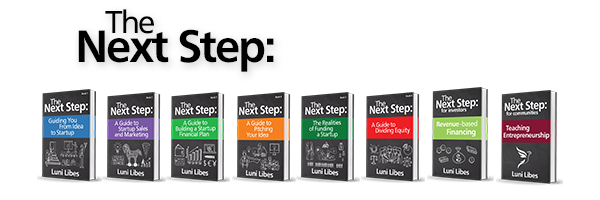
The Next Step series of books guides entrepreneurs step-by-step through the process of getting from idea to operational startup, breaking the paradigm of startup investing, and explaining years of lessons teaching entrepreneurship.
Podcast
The Next Step: podcast shares the lessons from the books plus other advice, anecdotes, and interviews, all in bite-sized audio pieces.
Accelerator & Investments
Fledge is a global network of conscious company accelerators, providing intense guidance, mentorship, investment, and support for a small set of entrepreneurs.
Africa Eats is an investment holding company focused on lowering hunger and poverty in Africa through for-profit solutions. The first spin-off of Fledge, it builds upon the work of a few dozen Fledge alumni who are building the food/ag supply chain across Africa.
And despite writing checks to entrepreneurs, I still consider myself first and foremost an entrepreneur, and as such every so often I simply have to create something new, such as:
The philanthropic investing service at Realize Impact, a 501c3 public charity that I co-founded, which lets any philanthropist turn a donation into an impact investment.
I hope something from this long list is of help to you.
The last time I found a book explaining the workings of a stock exchange was literally called The Work of the Stock Exchange, describing the New York Stock Exchange in 1922. Confusion of Confusions is a bit older. 234 years older. Published in 1688, describing the Amsterdam Stock Exchange. One might assume that the first-ever stock exchange back in the 17th Century would be lacking most of the...
I fell into another nostalgic computing rabbit hole, this one a few years later, looking at how the Xerox STAR and Apple Lisa could have succeeded, wildly, bringing the graphical computing era forward by almost a decade. That story begins with an earthquake, a few months before Apple’s IPO. A quake that puts the company’s existence in peril and ends up waking up Xerox to the...
A talk by Richard Hamming. Bellcore, 7 March, 1986 Transcript I have given a talk with this title many times, and it turns out from discussions after the talk I could have just as well have called it “You and Your Engineering Career,” or even “You and Your Career.” But I left the word “research” in the title because that is what I have most studied. From the previous chapters, you have an...
Why does Africa lag behind the rest of the world as measured by economic development? Why didn’t Africa follow along with the growth of the Asian Tigers, China, India, and Southeast Asia? What was missing? Joe Studwell gives a plausible explanation in his new book, How Africa Works. TL;DR, the answer is population density. That isn’t a factor that I had ever considered, as Africa...